Linearization and Directional Derivative
Linearized increment of a function
The figure below shows a function \(f\) that is nonlinear with respect to \(x\).
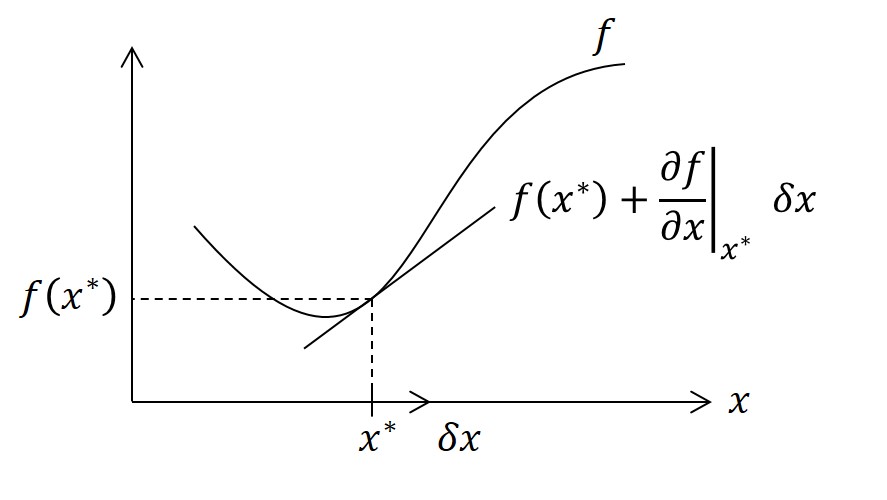
Figure 1.1 A function \(f\) and a linear function that has the same value and slope as \(f\) at \(x^*\).
In the figure there is a linear function that has value of \(f(x^*)\) and slope of \((\partial{f}/\partial{x})\vert_{x^*}\) at \(x^*\). This function is linear with respect to \(\delta{x}\) which is a coordinate whose origin is at \(x^*\). The fact that this linear function adopts \((\partial{f}/\partial{x})\vert_{x^*}\) as its slope ensures that it captures the local increasing and decreasing tendencies of \(f\) over a sufficiently small interval around \(x^*\), even though it does not do so at a location far from \(x^*\). Therefore, within a narrow domain of \(\delta{x}\), the increment of \(f\) at \(x^*\) can approximately be expressed by using the linear function as follows:
\[f(x^*+\delta{x})-f(x^*)\approx\left.\dfrac{\partial{f}}{\partial{x}}\right\vert_{x^*}\delta{x}. \tag{1.1}\]From now on, we denote the linearized increment of \(f\) at any location of \(x\) as \(\delta{f}\):
\[\delta{f(x,\delta{x})}=\dfrac{\partial{f}}{\partial{x}}\delta{x}. \tag{1.2}\]Note that \(\delta{f}\) and its slope are functions of \(x\) meaning that the location to be linearized is not determined. For the sake of further discussion, let us assume that \(x\) is a function of \(\xi\), \(\eta\), and \(\zeta\). In this case it can be said that \(\delta{x}\) in Equation (1.2) is the linearized increment of \(x\) with respect to \(\delta\xi\), \(\delta\eta\), and \(\delta\zeta\) which are small perturbations of \(\xi\), \(\eta\), and \(\zeta\), respectively:
\[\delta{x}=\dfrac{\partial{x}}{\partial{\xi}}\delta{\xi}+\dfrac{\partial{x}}{\partial{\eta}}\delta{\eta}+\dfrac{\partial{x}}{\partial{\zeta}}\delta{\zeta}. \tag{1.3}\]Substituting Equation (1.3) into Equation (1.2) leads to
\[\delta{f}=\dfrac{\partial{f}}{\partial{x}}\dfrac{\partial{x}}{\partial{\xi}}\delta{\xi}+\dfrac{\partial{f}}{\partial{x}}\dfrac{\partial{x}}{\partial{\eta}}\delta{\eta}+\dfrac{\partial{f}}{\partial{x}}\dfrac{\partial{x}}{\partial{\zeta}}\delta{\zeta}. \tag{1.4}\]Note that this equation follows the chain rule.
Directional derivative
The linearized increment of \(f\) in Equation (1.2) can be generally expressed as \(Df(x)[\delta{x}]\) which denotes
\[Df(x)[\delta{x}]=\left.\dfrac{\partial{f(x+\epsilon\delta{x})}}{\partial{\epsilon}}\right\vert_{\epsilon=0}, \tag{1.5}\]where \(Df(x)[\delta{x}]\) is called the directional derivative. The equation below explains how the directional derivative denotes the linearized increment.
\[\left.\dfrac{\partial{f(x+\epsilon\delta{x})}}{\partial{\epsilon}}\right\vert_{\epsilon=0} =\left.\dfrac{\partial{f(x+\epsilon\delta{x})}}{\partial{(x+\epsilon\delta{x})}}\right\vert_{\epsilon=0}\dfrac{\partial(x+\epsilon\delta{x})}{\partial{\epsilon}} =\dfrac{\partial{f}}{\partial{x}}\delta{x}. \tag{1.6}\]If \(x\) is a function of \(\xi\), \(\eta\), and \(\zeta\), according to Equations (1.3) and (1.4), the directional derivative is
\[Df(x)[\delta{x}]=Df(x)[Dx(\xi)[\delta{\xi}]]+Df(x)[Dx(\eta)[\delta{\eta}]]+Df(x)[Dx(\zeta)[\delta{\zeta}]]. \tag{1.7}\]